
Preparing our Reference Black-Water Holding Tank
5Introduction
While the Solarid Toilet doesn’t care what it empties into, it must empty into something. Because there’s no water, contents must drop straight down. While theoretically, a bathroom sink’s water could be plumbed into the downward pipe between the Solarid Toilet and the holding tank to allow a 45° slope, this hasn’t been tested yet.
A couple of factors determine the size and shape of the holding tank:
A tank that is higher than its other two dimensions is preferred, but can rarely be used, as most Solarid Toilet installations are on the ground floor. A deep hole can be difficult, and if there is groundwater close to the surface or heavy rains, and buried tank that is mostly empty must also be anchored. However, in regions where there are deep winters and the holding tank must be outside, having it mostly buried so that the bottom of the tank is below the frost line may be necessary.
Larger tanks are more expensive, but the larger the tank, the more uses it has before it needs to be emptied. If only the Solarid Toilet is going into a tank, then a 250-gallon tank for a family of four will only need to be emptied every 1-2 years. However, if any water drains into the tank as well, then going larger may be necessary if there is room and the budget.
The Tank
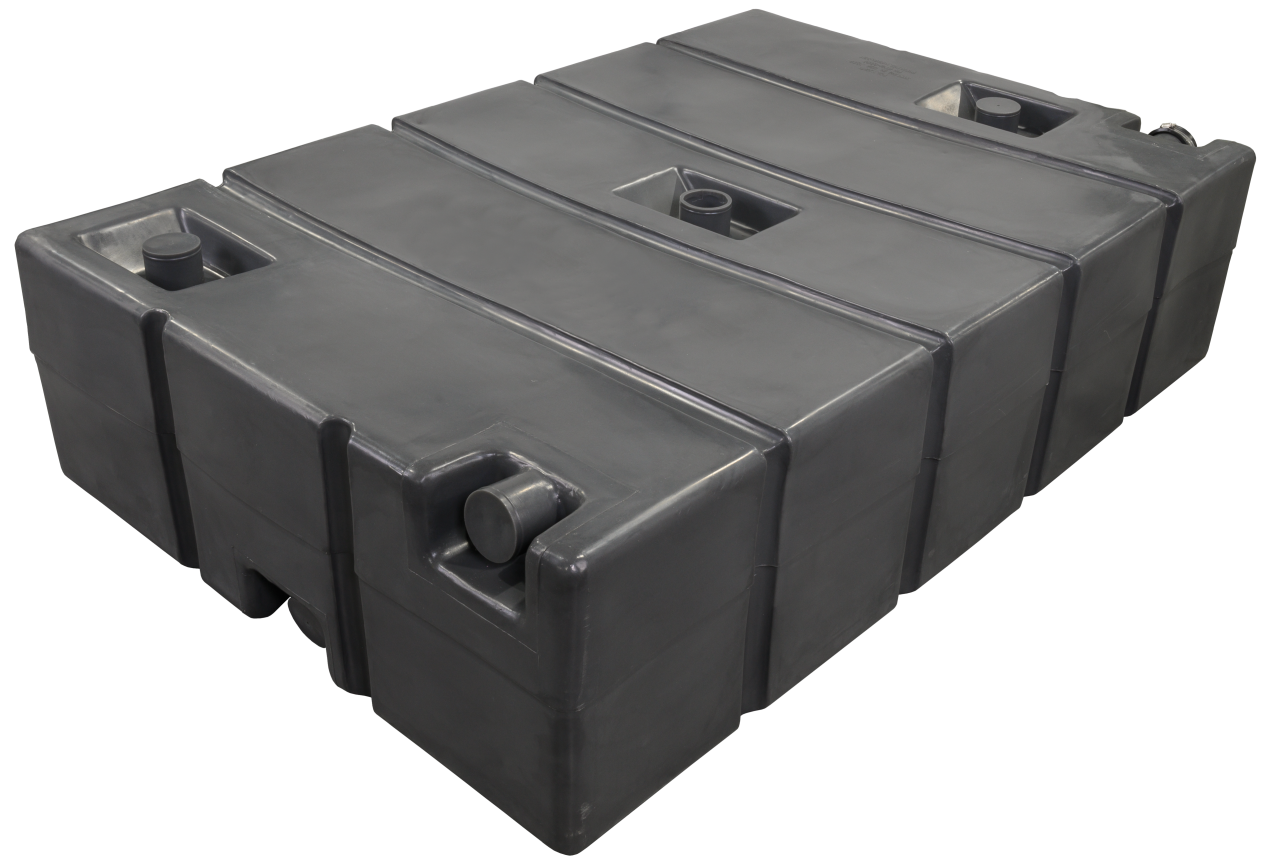
Based off of the factors listed above, we chose the PolyJohn 250 gallon holding tank. While it isn’t optimally shaped with height being the largest dimensions, we’ve noticed that it fits most install sites the best.
Inlet for the Solarid Toilet
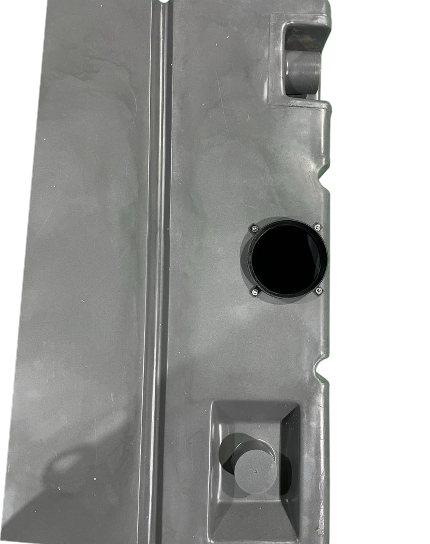
From the edge of the tank that has a capped 3” pipe stubbed up in the corner (this will become our vent), cut a 6” hole in the middle, as close to the wall as possible.
Screw down the coupler that allows a 6” sewer pipe to connect to this opening.
Note: the coupler in this picture is custom made by us. If you are sourcing and preparing your own tank and need this, we can include it as part of the purchase of the Solarid Toilet system.
Waste Slide
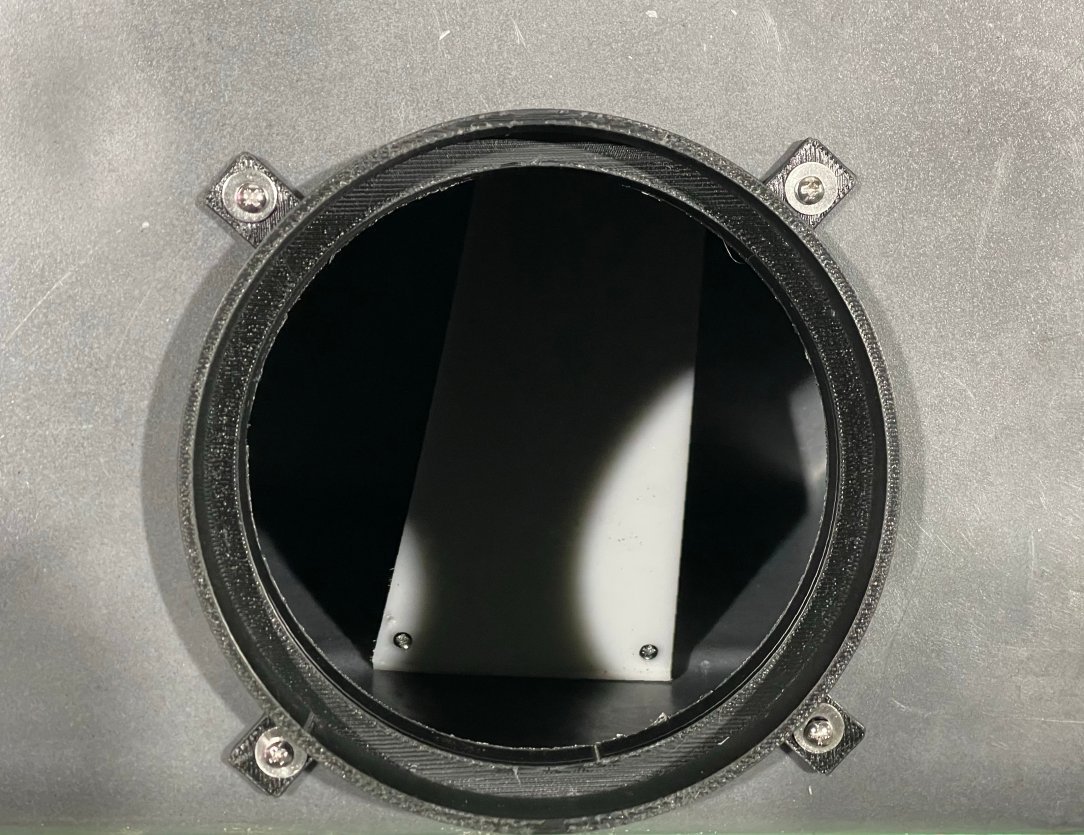
Screw a 4” x 14” piece of HDPE (or other smooth/slippery material) about halfway down from the opening.
Why? Because the tank isn’t too high, and liquid is minimal, we want to help disperse solid waste and toilet paper, preventing a pyramid or pile directly underneath the inlet.
Vent
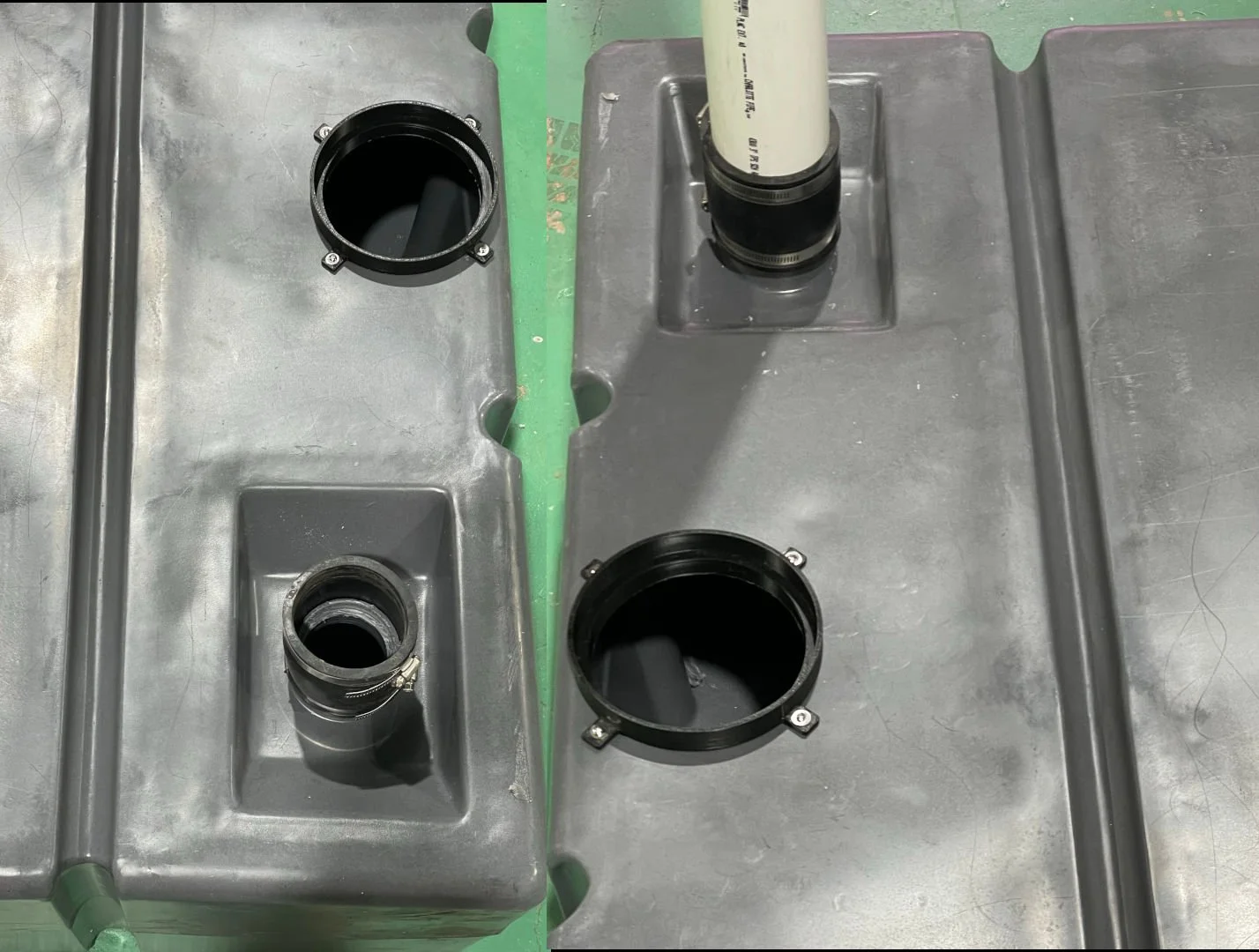
In the corner next to the Solarid Toilet inlet, use a 2-3/4” hole saw to create an opening in the 3” stubbed pipe.
A coupler is used to connect a 3” PVC pipe for venting. The vent pipe should go up at least 10’, or above the roof line.
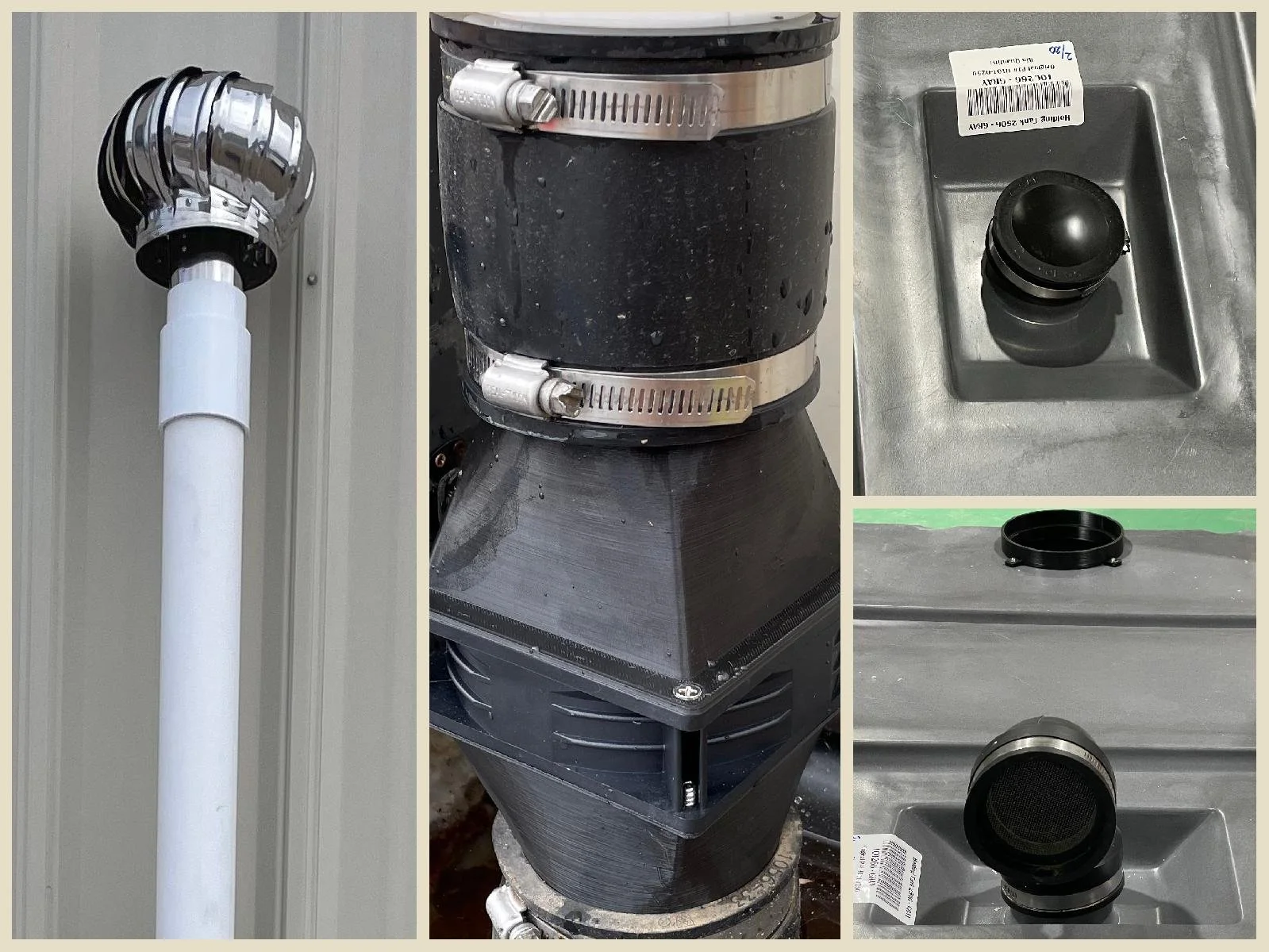
Venting Options
The amount of venting and evaporation from the tank depends on the amount of liquid expected.
If just the Solarid Toilet is being connected, where the only liquid is urine, then the end of the vent pipe can be either passively covered, or have a wind turbine connected to it. The hole in the center of the tank should also be capped.
If the bathroom sink or other water sources will also enter the tank, such that it is beneficial to have some of it evaporate, then:
add a powered fan to the vent (a 12VDC powered fan that connects inline with the 3” pipe can be purchased from us) and
replace the capped hole in the center of the tank with a screen-covered elbow.
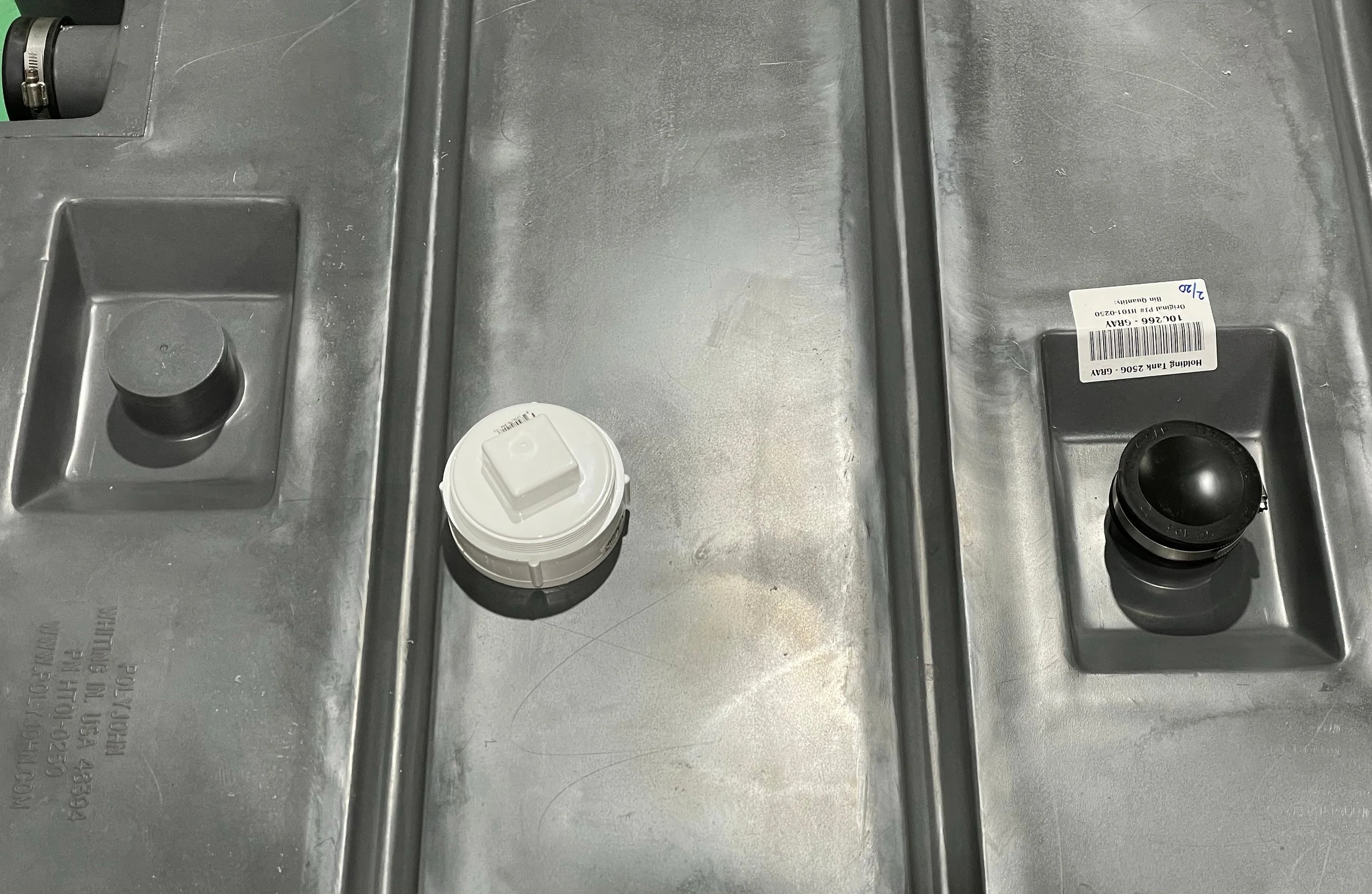
Clean-out
We need an outlet on the other side of the tank to provide access for a pump truck. On the opposite side of the tank from the inlet, make an opening with a 4” hole saw and glue in a 4” clean-out and cap.
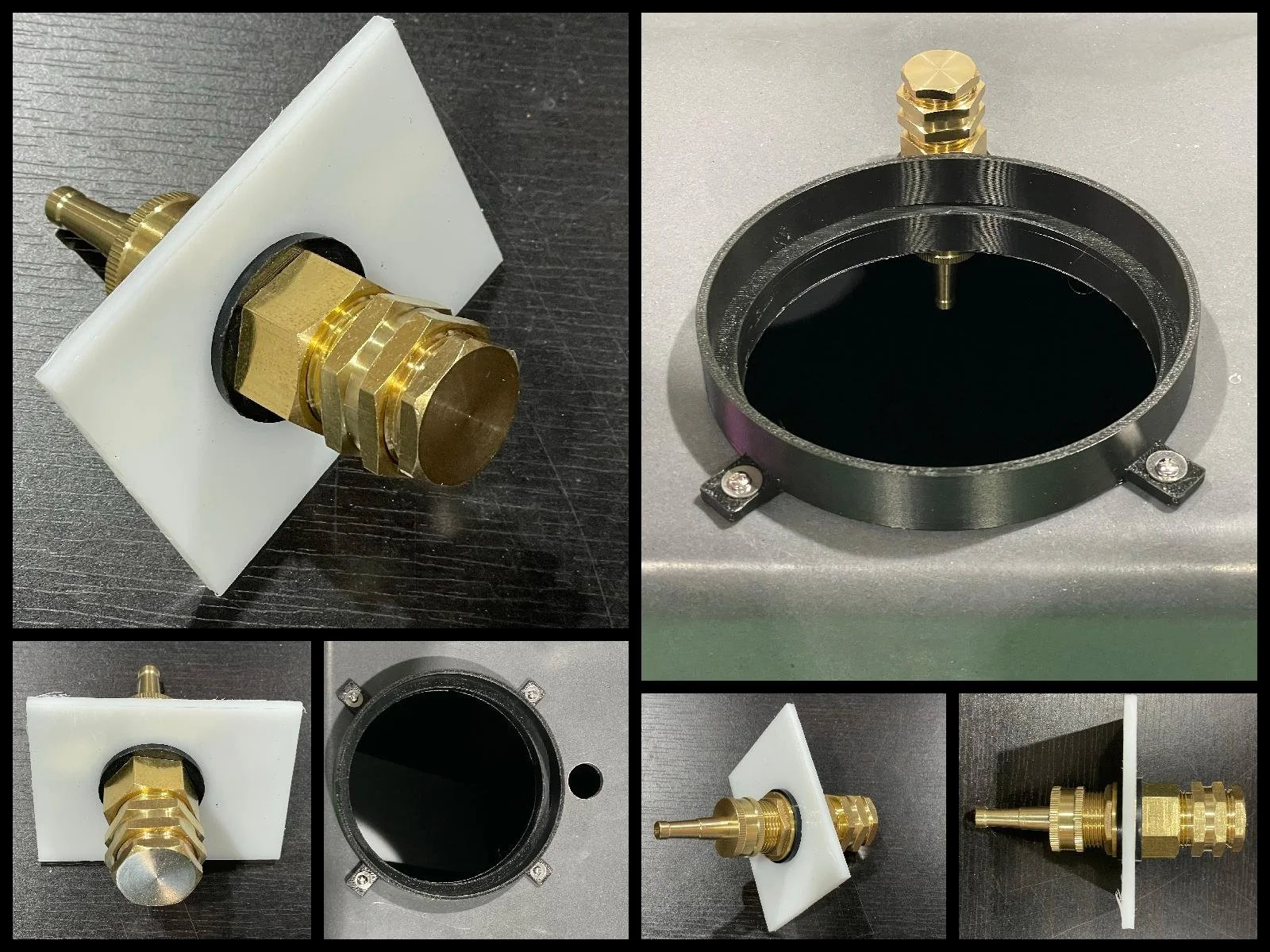
Hose Connector
For all installation where the tank’s height is smaller than its other two dimensions, a hose connection should be added near the inlet. This will help when the tank gets pumped out by breaking up the toilet paper pile and moving it to the other end of the tank.
The parts that make us this connection — from the bottom up — are a jet nozzle, a bulkhead connection (3/4” male hose connector to 3/4” female NPT), an NPT to hose connector adapter, and a screw-on cap. Ideally, the bulkhead connection would have a 3/4” female hose connection instead of NPT threads so that the adapter wouldn’t be necessary, but I can’t find this part.
The hole size required for this bulkhead is 1-1/16”.